Expand description
A worked end-to-end simulation: classical computation of the average X
magnetization following a sudden quench in a 2D transverse-field Ising
model. The lattice is small enough to fit in a single 64-bit Pauli word
(W = 1) but large enough that exact diagonalization is already painful
(2^36 ≈ 7 × 10¹⁰ amplitudes for the 6×6 case). Pauli propagation with
modest truncation gets the answer in seconds-to-minutes.
§Setup
Hamiltonian, on an Lx × Ly lattice with periodic boundary conditions:
H = -J · Σ_⟨i,j⟩ Z_i Z_j - h · Σ_i X_iwith J = h = 1 (the model is near its 2D quantum critical point — the
exact critical ratio is h/J ≈ 3.044 in 2D, but J = h is a convenient
non-trivial point). The initial state is |+⟩^⊗N, a +1 eigenstate of
every single-qubit X, and the observable is the average X magnetization:
O = (1/N) · Σ_i X_iThe Trotter decomposition is first-order with step δt = 0.05:
U(δt) ≈ exp(-i·δt·h·Σ X_i) · exp(-i·δt·J·Σ Z_i Z_j)Evolve to t_max = 2.0 / J over 40 steps.
§Strategy
We Heisenberg-evolve the observable O(t) = U†(t) · O · U(t) rather
than the state, then read off ⟨+...+| O(t) |+...+⟩ from the resulting
Pauli sum. This is the natural workload for Pauli propagation: the
observable starts as N weight-1 terms and grows under the Trotter
circuit; the wave function is never stored.
The four ingredients we need are: (1) the per-step Circuit, (2) the
initial observable as a PauliSum, (3) the propagation loop, and
(4) the observable-to-scalar projection.
§Per-step circuit
PauliRotation represents exp(-i·θ·P/2), so the angle for a single
Z_i Z_j bond at coupling J and time step dt is θ = 2 · J · dt,
and likewise θ = 2 · h · dt for an X_i site. The generator for a
Z_i Z_j bond is built by multiplying single-qubit Zs — the engine
returns the right x / z bitmasks plus an i^k phase (which is
+1 for two distinct Pauli Zs, but we go through mul_assign so the
pattern generalises to mixed generators).
use paulistrings::{Circuit, PauliString};
use paulistrings::channel::PauliRotation;

fn qubit_index(x: usize, y: usize, lx: usize) -> u32 {
    (y * lx + x) as u32
}

/// One Trotter step `U(dt) = exp(-i·dt·h·ΣX) · exp(-i·dt·J·ΣZZ)`.
fn trotter_step(lx: usize, ly: usize, dt: f64, j_coupling: f64, h: f64) -> Circuit<1> {
    let n = lx * ly;
    assert!(n <= 64, "PauliString<1> covers up to 64 qubits");
    let mut circuit = Circuit::<1>::new(n);

    // ZZ rotations on every nearest-neighbour bond (PBC).
    for y in 0..ly {
        for x in 0..lx {
            let i = qubit_index(x, y, lx);
            let right = qubit_index((x + 1) % lx, y, lx);
            let down = qubit_index(x, (y + 1) % ly, lx);
            for partner in [right, down] {
                let mut gen = PauliString::<1>::z(i);
                gen.mul_assign(&PauliString::<1>::z(partner));
                circuit.push(PauliRotation::<1> {
                    support: vec![i, partner],
                    gen_x: gen.x,
                    gen_z: gen.z,
                    theta: 2.0 * j_coupling * dt,
                });
            }
        }
    }

    // Transverse-field X rotations on every site.
    for site in 0..n as u32 {
        let gen = PauliString::<1>::x(site);
        circuit.push(PauliRotation::<1> {
            support: vec![site],
            gen_x: gen.x,
            gen_z: gen.z,
            theta: 2.0 * h * dt,
        });
    }

    circuit
}
Push order matters under Direction::Heisenberg: the engine iterates
channels in reverse and applies each one’s adjoint. With ZZ pushed first
and X pushed last, the per-step state-evolution operator is
U_X · U_ZZ, and Heisenberg evolution of O correctly computes
U_ZZ† · U_X† · O · U_X · U_ZZ.
§Initial observable
(1/N) · Σ_i X_i is N weight-1 Pauli terms with equal coefficient.
BuildAccumulator is the standard ingestion path: insert terms one at
a time, call .finalize() to get a sorted-and-deduplicated PauliSum.
use paulistrings::{BuildAccumulator, PauliString, PauliSum, Phase};
use num_complex::Complex64;

fn x_magnetization(lx: usize, ly: usize) -> PauliSum<1> {
    let n = lx * ly;
    let inv_n = Complex64::new(1.0 / n as f64, 0.0);
    let mut acc = BuildAccumulator::<1>::new(n);
    for site in 0..n as u32 {
        acc.add_term(PauliString::<1>::x(site), Phase::ONE, inv_n);
    }
    acc.finalize()
}§Reading the result
For a single-qubit Pauli P, ⟨+|P|+⟩ equals 1 when P ∈ {I, X} and
0 when P ∈ {Y, Z}. By tensoring,
⟨+...+| P_total |+...+⟩  =  ∏_i ⟨+|P_i|+⟩
                         =  1[z-part of P_total is all zero]
So the expectation value is the sum of Re(coeff) over PauliSum terms
whose z-bitmask is zero — a linear-time pass over the output sum.
use paulistrings::PauliSum;

fn expectation_plus_state(sum: &PauliSum<1>) -> f64 {
    let zero = [0u64];
    let mut total = 0.0;
    for i in 0..sum.len() {
        if sum.z()[i] == zero {
            total += sum.coeff()[i].re;
        }
    }
    total
}§Putting it together
The propagation entry point is propagate with
Direction::Heisenberg. We build the
per-step circuit once, then call propagate 40 times, recording the
expectation after each step.
use paulistrings::{propagate, Circuit, Direction, PauliSum};
use paulistrings::truncation::{And, CoefficientThreshold, TopN};

let (lx, ly) = (4, 4);
let (j_coupling, h) = (1.0, 1.0);
let dt = 0.05;
let steps = 40;

let trotter = trotter_step(lx, ly, dt, j_coupling, h);
let policy = And(CoefficientThreshold(1e-10), TopN(50_000));

let mut observable = x_magnetization(lx, ly);
let mut series = vec![(0.0, expectation_plus_state(&observable))];

for k in 1..=steps {
    observable = propagate(&trotter, observable, &policy, Direction::Heisenberg);
    series.push((k as f64 * dt, expectation_plus_state(&observable)));
}§Truncation
The 4×4 lattice grows from N = 16 weight-1 terms at t = 0 to ~10⁴–10⁵
terms within a handful of Trotter steps. The 6×6 grows much faster. Two
policies, composed with And, keep this
tractable:
| Lattice | CoefficientThreshold | TopN |
|---|---|---|
| 4×4 | 1e-10 | 50_000 |
| 6×6 | 1e-10 | 200_000 |
The first drops floating-point noise (and exact cancellations); the second caps total memory. Loosening either preserves the curves at early times and only changes long-time behaviour (where the answer is already truncation-limited).
§Result
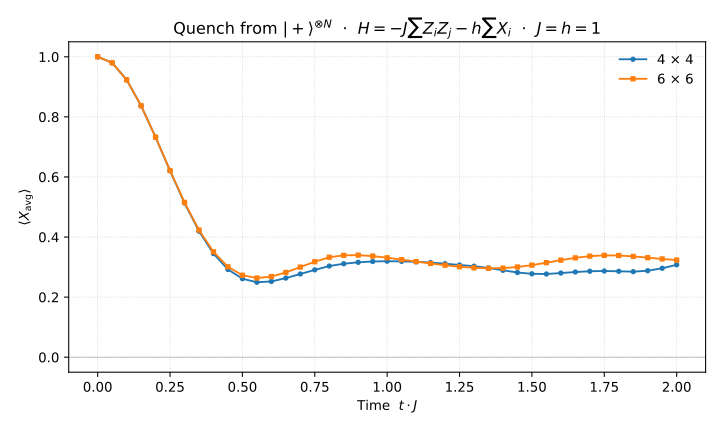
⟨X_avg⟩ starts at +1.0 (every spin in the |+⟩ eigenstate of X)
and decays as the ZZ coupling mixes X with Y and Z components.
The two lattice sizes track each other closely — finite-size effects
are visible but small in this time window — consistent with the
short-time evolution being dominated by local dynamics.
§Reproduce
From the repo root:
cargo run --example ising_2d_quench --release
python crates/paulistrings/examples/plot_ising_quench.py
The first command writes
crates/paulistrings/examples/output/ising_{4x4,6x6}.csv. The second
reads those and writes
crates/paulistrings/docs/examples/img/ising_quench.svg — the file
embedded above. Both files are committed to the repo so docs.rs and the
GitHub Pages preview render the plot without re-running the simulation.
Full Rust source (with CSV output and per-step progress logging):
crates/paulistrings/examples/ising_2d_quench.rs.